
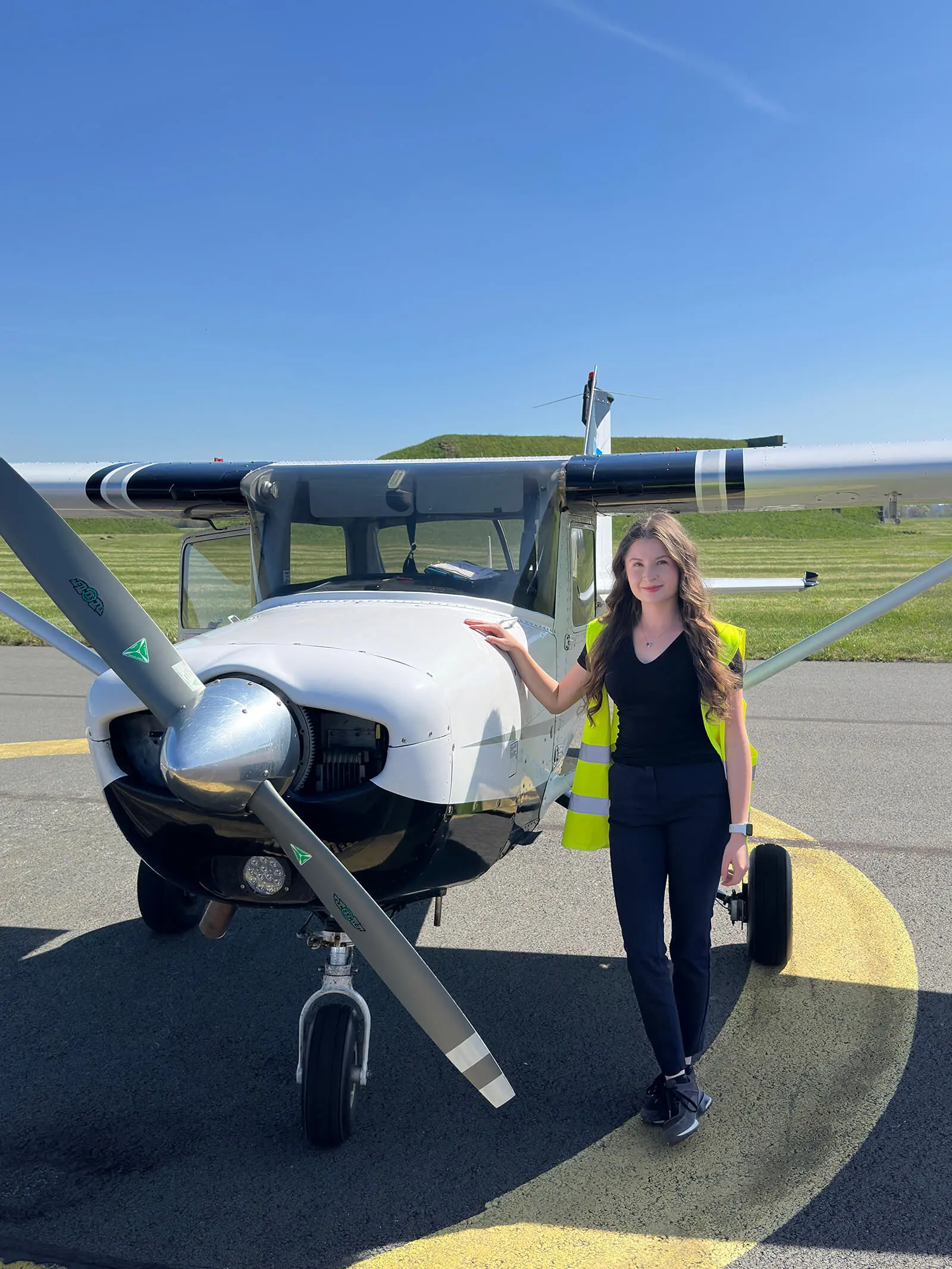
Since graduating from PBIS, Dominika has followed a clear and determined path into aviation. Today, she is studying to become a professional pilot at the Czech Technical University in Prague, working through the demanding ATPL (Airline Transport Pilot Licence) program.
Her story shows how curiosity, discipline, and the ability to connect academic interests with real-world goals can gradually turn a into a professional direction.
Discovering a Direction After PBIS
Since leaving PBIS, Dominika describes her journey as both challenging and rewarding. She is currently enrolled in the professional pilot program at the Czech Technical University in Prague, where the training involves an intense academic and technical workload. The ATPL program requires a deep understanding of aviation theory, physics, aerodynamics, and aircraft systems. Despite the difficulty, Dominika particularly enjoys subjects such as Principles of Flight, where students study the physical and mechanical principles that allow aircraft to stay airborne.
For her, the behind the demanding schedule remains clear. The first time she sat at the controls of an aircraft confirmed that aviation was exactly the path she wanted to pursue.
Early Interests at PBIS
Dominika joined PBIS in November 2015. At that time, her favorite subjects did not necessarily suggest a future in aviation. One subject she particularly enjoyed was chemistry, which she studied continuously from Year 7 through Higher Level in Year 13. Beyond the classroom, she remembers several experiences that shaped her time at school. One of her favorites was participating in the forensics club, where students conducted a full-scale forensic investigation based on a fictional crime scenario. While the activity was designed primarily as an engaging learning experience, it also encouraged analytical thinking and problem-solving—skills that later proved useful in aviation training.
Connecting Chemistry and Aviation
Dominika’s interest in aviation began to take shape during the IB Diploma Programme. While studying chemistry, she realized that the subject could be connected to aviation in practical ways. This realization became the foundation for her Extended Essay, which explored how principles of green chemistry could be applied to the production and disposal of aircraft de-icing fluids. Although the topic was academically demanding, connecting chemistry with aviation made the research far more meaningful for her. At the same time, she used her CAS (Creativity, Activity, Service) hours to pursue another important milestone: completing her first pilot’s licence. This combination of academic research and practical flying experience strengthened her decision to pursue aviation professionally.
Transitioning to University
Moving from PBIS to university life was not easy. Admission to the pilot program at the Czech Technical University is highly competitive. Only 15 students were accepted into the program during her intake. Once the program began, the academic demands quickly intensified. Dominika had to adapt to 12-hour study days, long lectures, and intensive mathematics courses. At times, the schedule included lectures lasting seven hours in a row, alongside four hours of mathematics each day.
The workload required strong discipline and time management.
Here, Dominika found that the IB Diploma Programme had prepared her well. The study habits she developed during IB particularly time management and research skills proved essential for handling the intensity of the aviation program.
Even the referencing and research techniques learned during her Extended Essay continue to be useful today. Another important advantage was language preparation. Her education at PBIS helped her achieve the highest possible level in the ICAO aviation English exam, which is required for professional pilots.
Academic Achievements So Far
Among her accomplishments so far, Dominika is particularly proud of completing all courses in her first semester with strong grades. The first semester of the ATPL program is known for its difficulty. Many students struggle to complete the coursework, and some do not continue into the second semester. The combination of advanced mathematics and complex aviation theory makes the successful completion of the first semester a significant academic milestone.
Motivation for the Future
Maintaining motivation during such an intense program requires a clear purpose. For Dominika, that motivation is simple. She knows that within two and a half years, if she continues working hard and successfully completes the program, she could be flying a commercial aircraft. That goal provides the drive to keep moving forward through long study days and demanding Long-Term Goals in Aviation Looking further ahead, Dominika already has a dream aircraft in mind. Her long-term goal is to one day fly the Airbus A350, one of the most advanced long-haul aircraft currently in service. By the time she reaches that stage of her career, many older aircraft models, such as the A330, may already be phased out. For Dominika, the A350 represents the kind of modern aviation technology she hopes to work with in the future.
Advice for Current PBIS Students
Reflecting on her own experience, Dominika offers practical advice for current PBIS students preparing for university. University study can be demanding, particularly in technically intensive fields like aviation. Success during the first year is not primarily about talent. It is about discipline and consistency. Students who learn to manage their workload effectively during the IB Diploma Programme will be far better prepared for the expectations of university life. Her message is clear: building strong study habits early can make the difference between struggling and succeeding when academic pressure increases. Dominika’s story demonstrates how curiosity in the classroom can evolve into a clear professional direction. Through determination, discipline, and the foundation she built at PBIS, she is steadily moving closer to her goal one day taking her place in the cockpit of a commercial aircraft.